Standard
Agree what good looks like for the work, the customer promise and the controls that matter.

How we work
Set the conditions
We clarify the business question, desired outcomes, sponsor, scope and the time your team can commit. We also agree the information and access needed, the responsibilities on both sides and how progress will be reviewed.
Our improvement cycle
The Scaleo Improvement Cycle connects Standard, Ownership, Assess, Plan, Execute and Learn—a practical path to a stronger manufacturing business. It connects good practice with real operating results and continuous improvement.
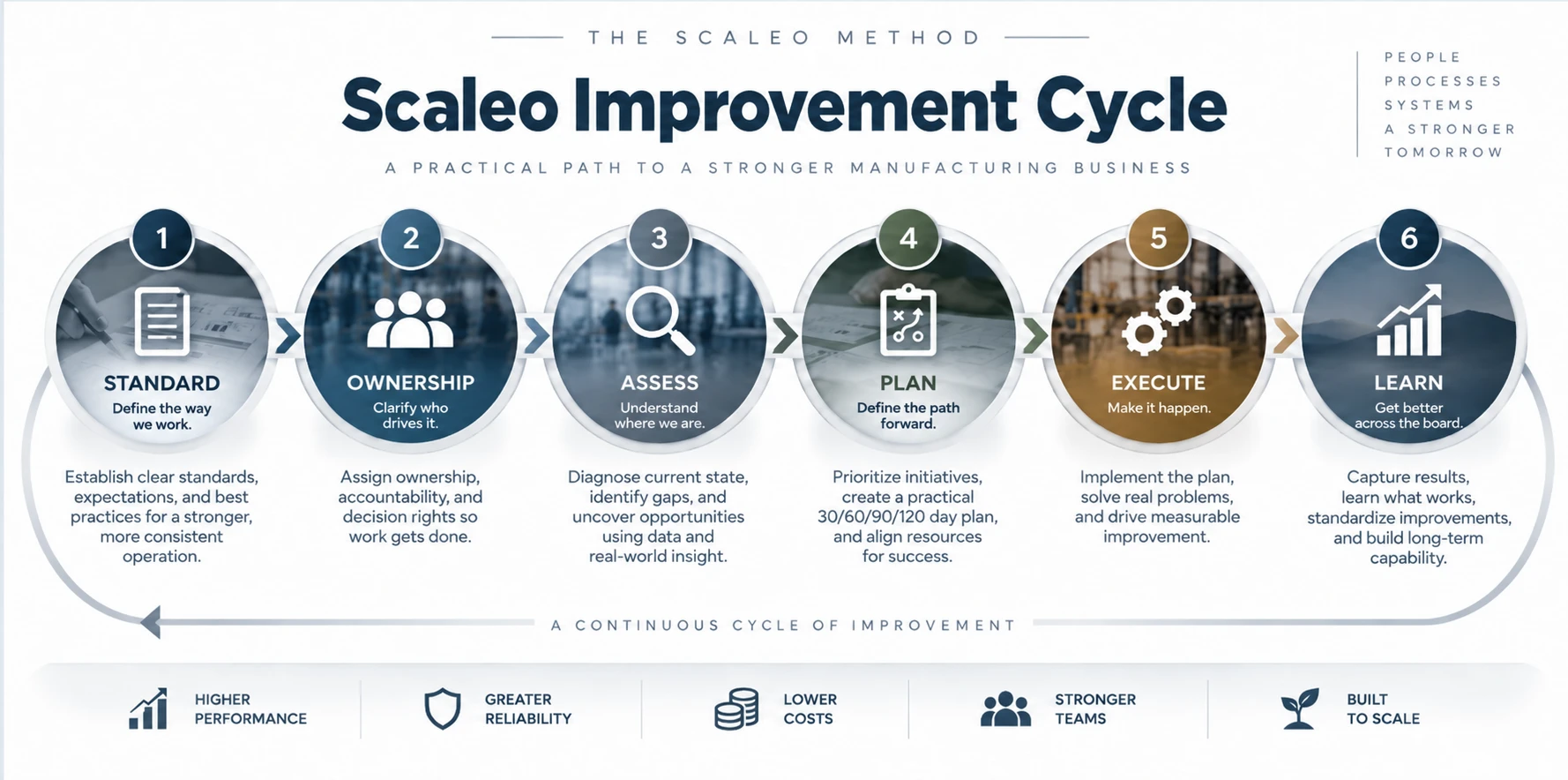
Agree what good looks like for the work, the customer promise and the controls that matter.
Confirm who is accountable, who does the work and who provides backup—with the authority, capability, time and tools to succeed.
Compare current practice with the agreed standard using conversations, documents, systems, data and observation. Separate what is supported from what still needs checking.
Choose the improvements that matter most. Set owners, measures, dependencies and milestones that fit the team’s capacity.
Work alongside the team to test and implement the changes, build capability and resolve issues as they arise.
Check results and sustained use. Capture what worked, update the standard or ownership when needed and choose the next improvement.
Tangible and owned
A shared view of strengths, constraints and evidence gaps. A prioritized improvement plan. Clear ownership and decision rights. Practical workflows, tools and measures. A record of actions and decisions. And a handoff that shows what your team can operate independently.

Build while improving
The work does not have to wait for a perfect company-wide design. We address urgent issues and suitable early improvements while building the foundations needed for the next steps.
We agree the conditions for stepping back at the start. That includes checking the team can run the work, handle exceptions, cover key absences and keep improving. Any additional support is separately agreed—not an automatic ongoing engagement.
Frequently asked questions
Not necessarily. We start with the work and your existing tools. Better configuration, cleaner data, clearer ownership or an integration may be enough. Buying or building comes after the business need is understood.
Yes—implementation and capability building can be part of the agreed engagement. We work with your team to put changes into practice, check adoption and transfer ownership. The proposal makes the support and responsibilities explicit.
An engaged sponsor, access to the right people and information, and enough time from the owners who will run the improvements. We agree that commitment before the work begins and reuse existing information where it is useful.
Timing depends on scope, complexity, access and capacity. We agree milestones and review points rather than promising the same result on the same date for every business.
We check the agreed outcomes, sustained use, ownership, team capability and remaining risks. Completion is an evidence-based decision—not just the end of a calendar period or delivery of a document.
Before accessing sensitive information, we agree how it will be used, who may access it and where it will be held. We also agree any use of AI or third-party tools. Please do not send confidential operating, financial or employee information through the website form.
Start a conversation
Tell us what you need the business to do next.